State Emergency Services:

Gas Leak, Emergency and Outage Checklist

From bushfires to flooding, when an emergency occurs we have stringent processes and standards in place to ensure your safety. Because natural gas is lighter than air, it dissipates quickly into the atmosphere in the event of a leak. However, you should still report any leak as gas may build up in confined spaces and can create a potentially dangerous situation.
Gas Emergency Checklist
If you smell gas Call 1800 GAS LEAK (1800 427 532) immediately.
If you smell gas or are concerned about gas appliance safety, immediately call: Gas Leaks and Emergency services on 1800 GAS LEAK (1800 427 532)
The Emergency operator will give you advice about what to do and if appropriate arrange for an engineer to visit within 1 or 2 hours and make the situation safe.
Please note, our emergency engineers do not repair appliances or internal home pipework. You may need to contact a licensed gas fitter to rectify these problems.
Remember, if you smell gas inside your building or home:
- Turn off all appliances and pilot lights.
- Turn off your supply at the gas meter.
- Open all doors and windows for ventilation.
- Contact your licensed gas fitter to investigate the leak.
Gas leak safety: what not to do
- Do not look for a gas leak with a naked flame or other ignition source.
- Do not operate electrical equipment close to a gas leak.
- Don't turn on or switch off any lights, use a telephone, or use a flashlight, at the risk of causing a spark that could start a gas fire.
- Don't smoke, light matches, or use a cigarette lighter inside or while on the property.
Your responsibilities
As the owner, you are responsible for the gas installation in your home or business, including any associated costs, and should use a licensed gas fitter to carry out any gas work required. Your gas fitter will be responsible for carrying out work at your gas meter outlet up to (and including):
- The gas appliance.
- The pipe work from the gas meter to the appliance.
- Any flues or ducts.
If a gas leak occurs between your gas meter location and your appliances, you should contact a licensed gas fitter to arrange a repair.
Locate a plumber/appliance store
If you are experiencing circumstances that make you vulnerable, you may be eligible for our Priority Services. Eligible customers may be able to access free gas appliance safety checks and repairs. Click here to find out more.
Our responsibilities
As your gas distributor, we are responsible for work on the gas meter and the gas distribution network (e.g. street mains and the pipework connecting these mains to your gas meter). If a gas leak occurs on the gas meter or on the gas distribution network, we are responsible for its repair, including any associated costs.
Gas outage information
If you're unexpectedly faced with a gas outage, we recommend that you:
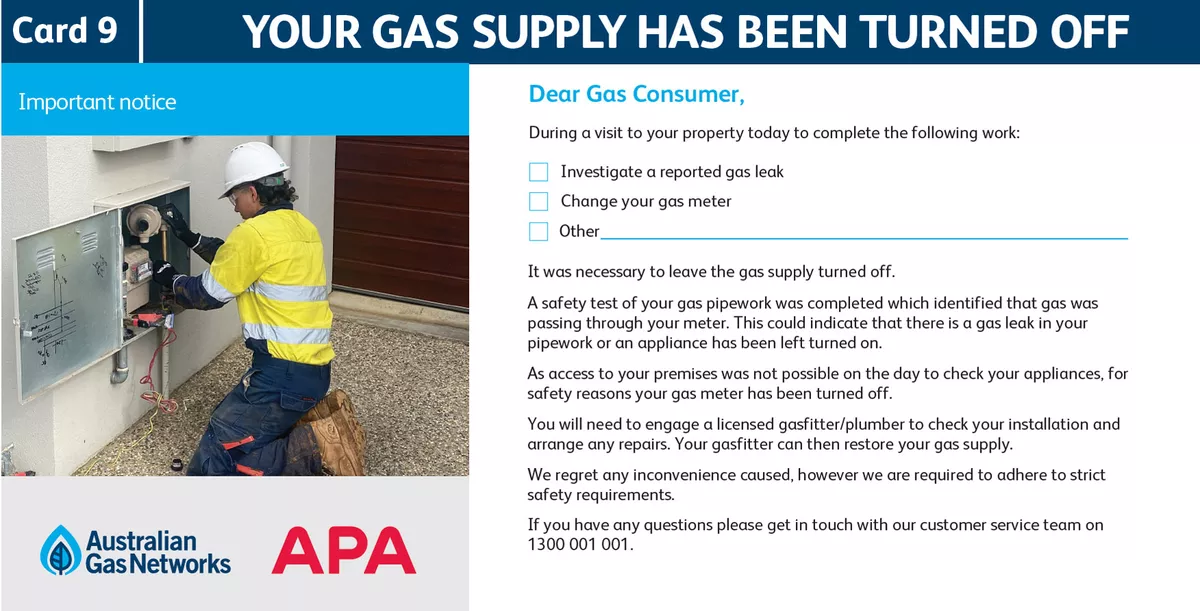
- Check your mailbox or front porch for a notification card from us or from our network operator, APA Group (click here to download an example). Sometimes this notification card is left in your meter box. These cards will tell you what's caused your outage and will provide you instructions on next steps.
- If you can't find any of our notification cards on your property, please contact our Gas Supply Faults hotline on 1800 898 220 for more information. Calling this hotline will advise you of any wider supply outages in your area, and you'll also be put in touch with our network operator, APA Group, for further assistance.
How to turn off your gas supply
1. Turn off all the gas appliances in your home.
This includes gas cooking appliances, heaters and your hot water unit (including the pilot).
2. Locate your gas meter.
This is usually found in a metal box attached onto the side of your house; commonly opposite the driveway or in your front garden.
3. Turn the gas meter off.
To do this, rotate the valve 90 degrees so that it reaches a horizontal position.
Natural gas bushfire information
If your property is near a bushfire event, you should turn off your natural gas supply whether you decide to leave your home or stay.
The valve to turn off your supply is a quarter turn valve; you’ll find it on the side of your gas meter assembly. Remember to keep the area surrounding the gas meter free of obstructions and clear of combustible materials.
If your home is affected by a bushfire, don’t turn on the gas supply until a gas fitter has tested it. The gas fitter will confirm that there are no gas leaks or damage before the supply is turned back on.
In the event of an emergency, call the Gas Leaks and Emergency services on 1800 GAS LEAK (1800 427 532).

Additional Resources
Country Fire Authority:
Country Fire Service:
Police, Fire and Emergency Services:
- www.pfes.nt.gov.au (for NT residents only)
- www.fire.qld.gov.au (for QLD residents only)